Hunza's spring blossom usually arrives from late March into mid-April, and the first thing to know is that most of what people call the cherry blossom here is actually apricot, with cherry and other fruit trees flowering alongside it. The bloom moves up the valleys with elevation and changes from year to year with the weather, so the right plan for 2027 is a window, not a fixed date.
When is the Hunza blossom season in 2027?
In a typical year, the Hunza blossom runs from late March to mid-April, starting in the lower valleys and climbing towards the higher villages over a few weeks. It shifts with each winter and spring, so no honest operator can promise a date in advance. Plan around a window, not a day.
We are not going to publish exact 2027 peak dates, because nobody can know them this far out. A cold, late winter pushes everything back; a warm early spring brings it forward, sometimes by more than a week. What stays reliable is the order of events: low ground first, high ground last, with each orchard flowering for roughly a week or so before the petals drop.
That order is useful. Because the bloom travels up the valley, a trip that spends several days moving from lower to higher villages gives you more chances to catch a village at its best than a single-night stop ever could. It is the main reason we build our blossom itineraries around a spread of locations rather than one famous viewpoint.
| Area / elevation | Typical window | Notes |
|---|---|---|
| Lower valleys | Late March | First to flower; milder, warmer days |
| Karimabad / central Hunza | Early to mid-April | Most popular base; peaks mid-window |
| Upper Hunza / Nagar | Mid-April, sometimes later | Cooler; blossom trails the valley floor |
| Skardu / Baltistan | Early to mid-April | Khaplu and Shigar orchards; varies by village |
Read the table as a guide to the order, not a promise. Treat every window as approximate, and expect the same village to flower earlier or later in a different year. Our broader seasonal guide covers how spring compares with summer and autumn across both regions.
Where to see the blossom
The best-known blossom spots are Karimabad and the villages around it in central Hunza, including Altit and Baltit below the old forts. Hopper in Nagar gives the best view back across the valley, while in Baltistan the orchards of Khaplu and Shigar flower in roughly the same weeks.
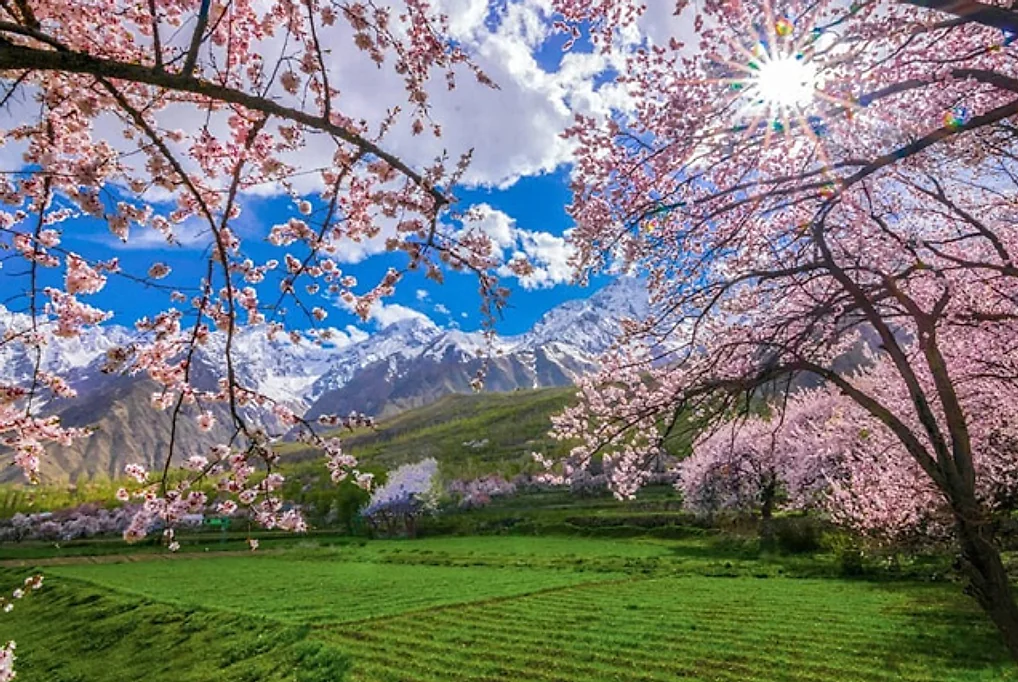
Karimabad is the natural base. Terraced orchards climb the slopes beneath Baltit Fort, and from the upper lanes you look across to the snow faces of Rakaposhi and Ultar. Walking down through the terraces at the start or end of the day, when the light is low and the crowds are thin, is the single best way to see it. The terraces and fields are owned and worked by local families, so we always walk the paths rather than cutting through the trees.
Across the river, Nagar is quieter and cooler, so its blossom tends to come a little behind the valley floor. Hopper, with its glacier and wide views over Hunza, is the place to go if you want the whole valley in a single frame, white and pale pink in the foreground and white peaks behind.
Baltistan offers a different feel. Skardu sits on a broad plain with sand dunes and lakes, and the orchard villages of Khaplu and Shigar sit in quieter side valleys with older stone-and-wood architecture. If you are choosing between the two regions, our guides to each place explain the character of the towns.
Apricot or cherry?
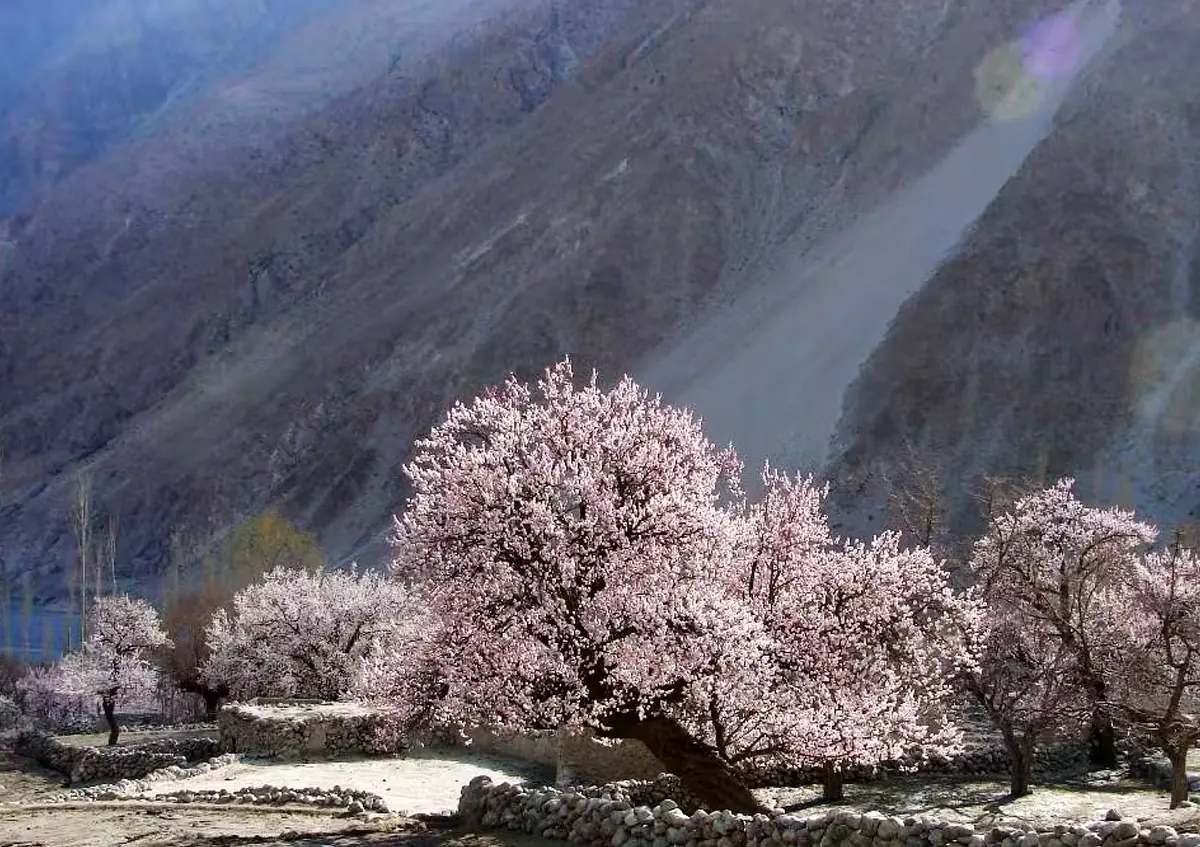
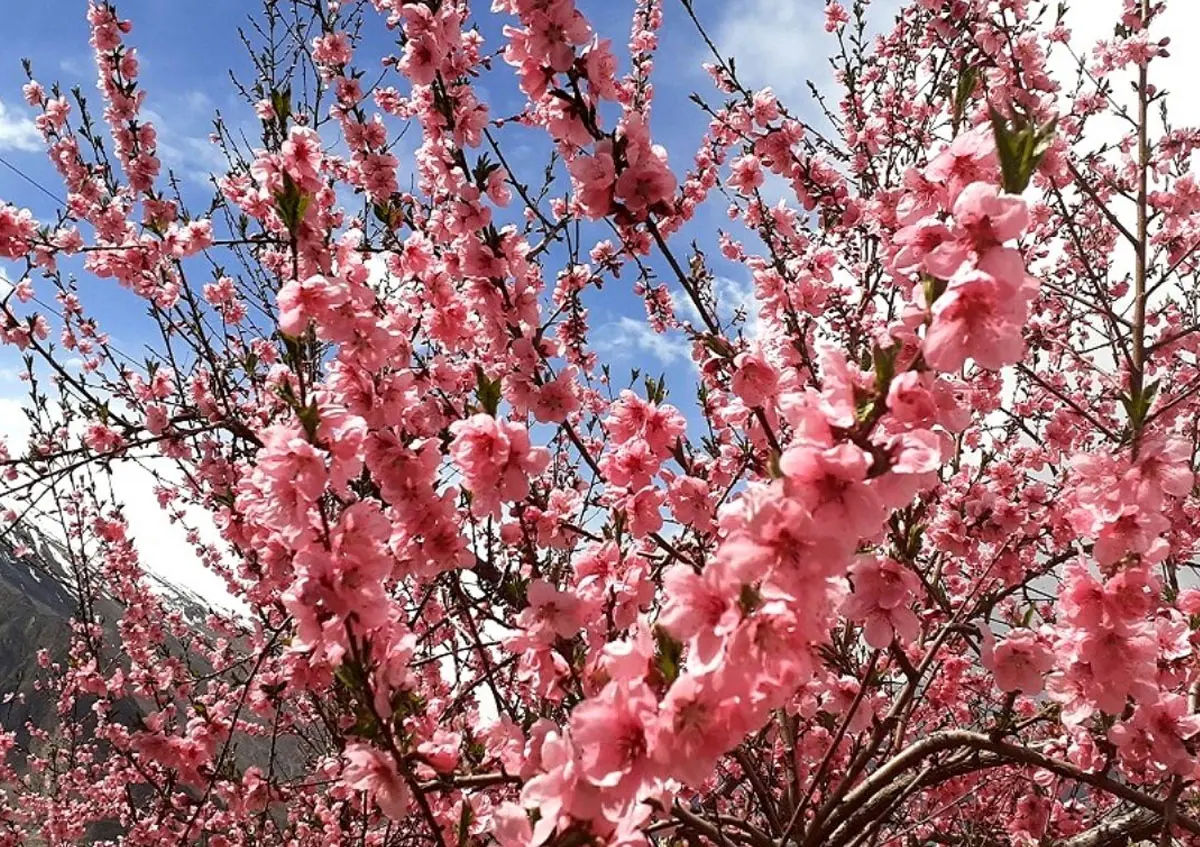
Mostly apricot. Apricot is the dominant orchard tree in Hunza and Baltistan, and its white-to-pale-pink blossom is what most visitors photograph in spring. Cherry and plum flower around the same weeks, with apple and other fruit trees following later, so the valleys carry several kinds of blossom, but apricot sets the timing.
This matters for expectations. If you arrive picturing the dense pink canopies of a Japanese cherry festival, you will see something different here: smaller, scattered trees, mostly pale, set inside working orchards and against rock and snow. Many people find it more striking for exactly that reason, but it is worth knowing before you book.
It also matters for the search term. People looking for Hunza cherry blossom are almost always describing the same event as the apricot blossom, and that is the season this guide covers. You will see cherry trees in the mix, especially in gardens and field edges, but the visual weight of the season is apricot.
What a blossom trip is like
A blossom trip is slow and photographic: short drives, orchard walks, village lanes and snow peaks behind pale flowers. Days can be mild, while mornings and evenings stay cold, and spring weather can change quickly. It suits people who want scenery and culture without any trekking.
Spring is shoulder season in the mountains, so you will find the valleys calm. Villagers are busy with the first fieldwork of the year, guesthouses are quiet, and the tourist crowds of high summer are still some weeks away. Pack layers, including a warm jacket for early starts and evenings, and a light rain layer, as April showers are normal.
For photographers, the usual advice applies: shoot early and late, look for blossom framed against dark rock or snow rather than against a pale sky, and give yourself a spare day in case cloud sits on the peaks. Honest expectations help too. You may get a perfect clear morning, or you may get soft grey light that actually flatters the petals, and both are part of a mountain spring. A good itinerary leaves room for either.
- Orchard walks in the early morning and late afternoon, when the light is best and the temperature is pleasant.
- Time in the old quarters of Karimabad, Altit and Baltit, with their forts and stone lanes.
- Viewpoints such as Hopper, with open views over the valley and its glaciers.
- Tea and meals in family-run guesthouses, with local dishes and dried apricot products.
- In Baltistan, easy day outings from Skardu to the orchard villages of Khaplu and Shigar.
Our Hunza route is the Hunza Apricot Blossom Tour, from $1,150 per person for a group of seven to ten, and the price falls as the group grows. For Baltistan, the Skardu Blossom Tour starts from $950 on the same basis. If you want a general Hunza trip that you are happy to time for spring, the Hunza Valley Classic is also from $1,150 per person.
How to book around the window
Book for the middle of the typical window and keep your dates flexible by a few days if you can. We can tell you how the season is shaping up as your dates approach. Hold flights with some flexibility, and tell us your priorities: peak bloom, fewer crowds, or a mix.
Because the bloom can arrive earlier or later than usual, we suggest a few simple rules. Choose a trip long enough to move between more than one elevation, so that if one village is early or late, another is at its best. Avoid building your whole itinerary around a single day. And ask for a flexible booking arrangement where possible, rather than paying for every item far in advance.
If you can only travel in a short fixed period, say so when you contact us. In some years that period will line up well with the bloom, and in others you may see the tail end or the first buds. We would rather tell you that plainly than sell you a date. A trip that adds a day or two at higher elevations is often a sensible hedge against an early spring, and a lower-valley stay helps against a late one.
Mountain roads in spring can also be affected by late snow or landslides. We route around this as conditions allow, and we will confirm current road conditions before you travel. For permits, paperwork and entry requirements, please check with us for the latest details.
Plan this with us. We are a Skardu-based, Balti-run operator licensed by the Department of Tourist Services (DTS No. 008), and we run every trip ourselves with no middlemen. Tell us your approximate dates, group size and whether you want Hunza, Skardu or both, and we will suggest where in the window to place your days.