Skardu Blossom Tour
Request a quoteExplore
A ten-day photography tour from Islamabad up the Karakoram Highway to Hunza and across to Skardu, timed for April blossom or autumn colour, with early starts and time held at the best light.
Per person in USD, full-board — the larger your group, the lower the per-person cost. We confirm your exact all-in figure in writing before any deposit.
| Group size | Per person |
|---|---|
| 7–10 people | $1,800 |
| 4–6 people | $2,100 |
| 1–3 people | $2,600 |
Excludes international flights, Pakistan visa, insurance, personal equipment and tips.
Guaranteed small-group dates for the 2027 season. Prefer your own dates? Every trip can also run privately inside its season window.
| 5 Apr 2027 → 14 Apr 2027 | Book this date |
|---|---|
| 18 Sept 2027 → 27 Sept 2027 | Book this date |
| 28 Sept 2027 → 7 Oct 2027 | Book this date |
| 8 Oct 2027 → 17 Oct 2027 | Book this date |
The Pakistan Photography Tour is a ten-day journey from Islamabad up the Karakoram Highway to Hunza and across to Skardu, paced around light rather than around ticking off sights. We start early for sunrise, hold the group at a good viewpoint for as long as the light lasts, and keep the numbers small. It is timed for the apricot blossom of April or the autumn colour of late September and October, and it is a touring trip with short walks, not a trek.
The route follows the Indus gorge north from Besham to Chilas and Gilgit, then climbs the Hunza valley to Karimabad, Nagar and Passu, with Rakaposhi (7,788 m) in view for much of the way. From Hunza we return to Gilgit and take the Skardu road along the Indus to Skardu, where the valleys open into the dunes of Katpana, the lakes at Kachura and, in autumn, the edge of the Deosai plateau. We fly back from Skardu to Islamabad.
In Hunza the main locations are Eagle's Nest at Duikar, a ridge above Karimabad that looks over Rakaposhi, Ladyfinger and the valley at sunrise; the old forts of Baltit and Altit; the terraced fields around Karimabad; and, further up the valley, Attabad Lake, the Passu Cones and the Hussaini suspension footbridge. Across the river, the Nagar side gives a different angle on Rakaposhi. In the Skardu area we photograph the Indus and Shigar valleys, Shigar Fort, Shangrila at Lower Kachura Lake and the cold-desert dunes at Katpana. Each is worth more than one visit at different times of day, and we plan the days so that you can do that where the schedule allows.
We are honest about what this trip is. The drives are long, particularly on the first two days and the road to Skardu, and you will spend a good part of each day in a vehicle. Mornings are early, usually before six on sunrise days. Whether the peaks show depends on the weather, and no itinerary can promise a clear sky on a given morning, so we keep slack in the plan and use the free hours to return to a place when the cloud lifts. Nights at altitude are cold, and the high ground at Duikar and Deosai is colder still. The walks are short and optional. Your guide knows the valleys and the light and will advise, but this is not a formal workshop with tuition. It suits photographers of any level who want to be in the right place at the right time, and companions who are happy to wait while they work.
We travel in private vehicles with a driver and a local guide, staying in hotels and guesthouses with full board. The rooms are comfortable but simple in places, particularly at Chilas and Passu. Please ask before photographing people, especially women, and respect it when someone says no. Drones need permission from the authorities and we will advise you before the trip if you plan to bring one.
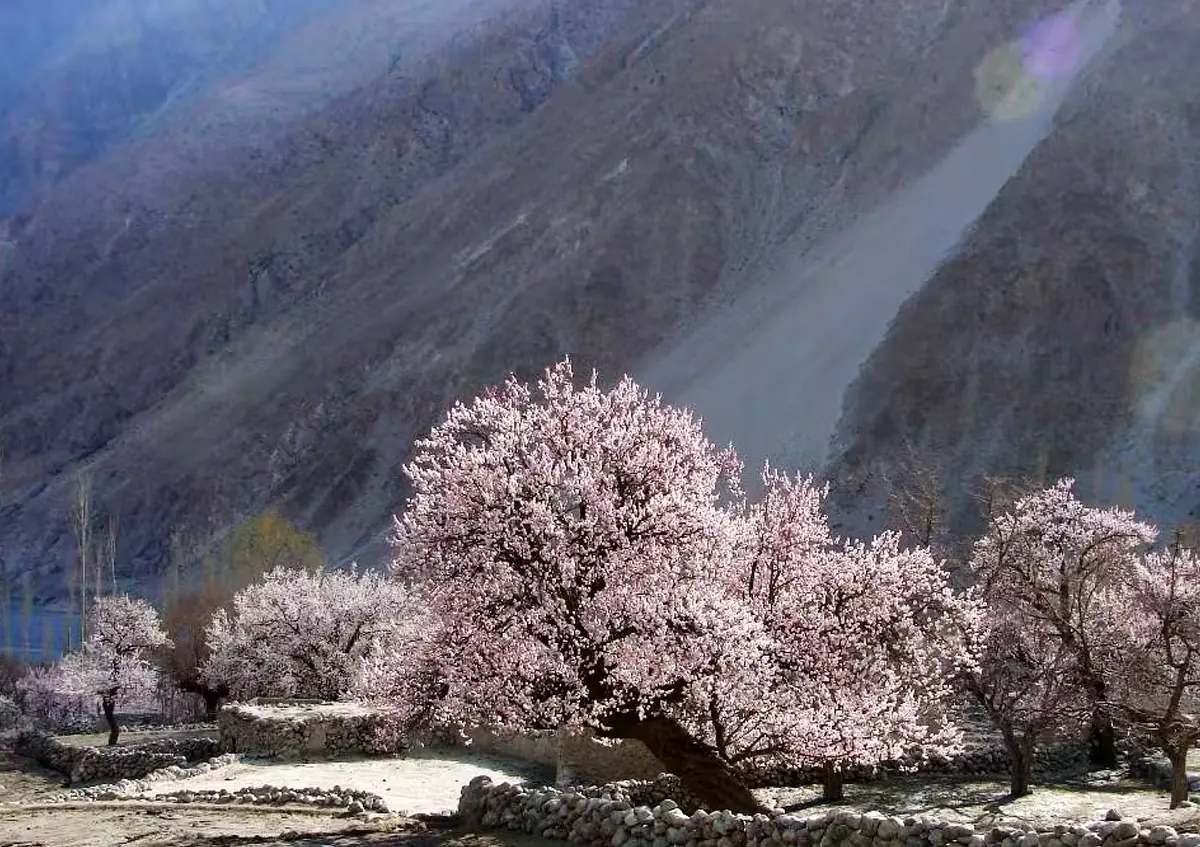
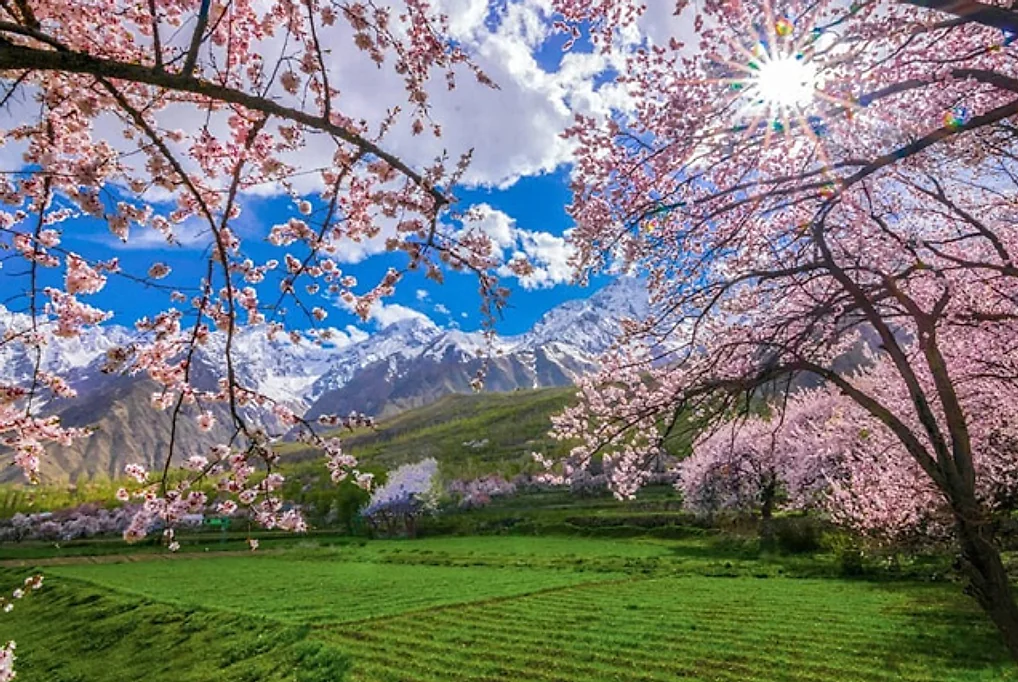
There are two windows, and you choose one. April brings the blossom to the Hunza and Skardu valleys with fresh snow on the peaks above. Late September and October bring the autumn colour, with settled weather and generally clear skies once the summer haze has gone. The exact timing of both shifts from year to year with the winter that went before, and we advise on dates for the season as it develops.
10 stages over 10 days, starting and finishing in Islamabad. Routes can be shortened, extended or privately dated.
An early start from your Islamabad hotel, at about six o'clock, for the Karakoram Highway: north to Besham, then along the Indus gorge through Kohistan to Chilas (about 1,250 m). It is a long day, usually eleven to thirteen hours with stops, on a road that can be slow where it is under repair. Most people arrive in Islamabad the evening before, and we can book that night for you. If the weather and the light allow, we stop where the gorge widens for the river and the canyon walls. We spend the night in a simple hotel in Chilas.
We leave early and drive to Gilgit, about four hours, with a first view of Nanga Parbat from the highway on a clear morning. Beyond Gilgit the road follows the Hunza River, and we stop at the Rakaposhi viewpoint near Ghulmet, where the mountain rises almost from the road. In all it is a seven to eight hour day to Karimabad (about 2,400 m), where we arrive in time for the late light on the terraced fields. We spend three nights in Karimabad.
A dark start for sunrise at Eagle's Nest, at Duikar (about 2,900 m), which looks across to Rakaposhi, Ladyfinger and the Hunza valley. We drive up from Karimabad on a rough road and finish with a short walk, then wait as the light reaches the peaks. After breakfast we visit Baltit Fort above the town and Altit Fort, the older of the two, with the old lanes below it. The afternoon is free to rest or to return to a viewpoint of your choice. In April the blossom around Karimabad is at its best on this day.
We cross the river to Nagar, a drive of about an hour and a half to Hopar, for a different angle on Rakaposhi and the glaciers that come down from the Nagar peaks. There are village lanes, orchards and a short optional walk to a viewpoint, and we let the weather decide how long we stay. We return to Karimabad for a free evening, and the light on the valley wall opposite is often good at sunset.
We drive up the valley into Gojal, about two hours without stops and longer with them. Attabad Lake, formed by a landslide in 2010, is a vivid turquoise on a clear day, and the highway now passes it through a series of tunnels. Further on we stop at the Hussaini suspension footbridge and at Passu to see the Passu Cones against the evening sky. The footbridge is in poor repair and crossing it is optional. We spend the night in a guesthouse at Passu (about 2,400 m), where it is colder than in Karimabad.
An early walk or short drive to a viewpoint for the sunrise on the Passu Cones and the Passu Glacier, then breakfast. In the middle of the day we drive back down the valley to Gilgit, a journey of five to six hours with stops, pausing again at Attabad Lake or the Rakaposhi viewpoint wherever the light is better than it was on the way up. We spend the night in Gilgit.
We leave Gilgit by the Skardu road, which turns off the highway near Jaglot, where the Gilgit and Indus rivers meet and, it is said, the Himalaya, Karakoram and Hindu Kush ranges come together. The road follows the Indus gorge through Rondu, and we make photography stops along the way. It takes six to seven hours, longer if the road is under repair. We reach Skardu (about 2,250 m) in the afternoon, in time for the dunes of Katpana at sunset if everyone is up to it. We spend three nights in Skardu.
A day in the Shigar valley, about an hour from Skardu: Shigar Fort, orchards and village lanes, and the wide gravel plains of the Shigar and Indus rivers, with the first hills of the Karakoram above them. We return to Skardu in the afternoon and stay on the road as long as the light is good. At sunset we go to the cold-desert dunes of Katpana, near Skardu, where the sand shows ripples in low light and the surrounding peaks catch the last colour.
An early start for the lake at Shangrila, near Lower Kachura, which is often calm and reflective at dawn. A short optional walk leads on towards Upper Kachura Lake. From late September to October, if the road is open and the weather allows, the afternoon is a drive up towards the edge of the Deosai plateau, which lies at about 4,000 m. It is cold and open up there, with treeless, rolling ground, and you will want warm layers. In April Deosai is closed by snow, so the afternoon is instead spent among the blossom in the villages around Skardu and at the fort above the town.
A morning flight from Skardu to Islamabad, about an hour and dependent on the weather. If the flight is cancelled, which happens, the alternative is a long drive down the Karakoram Highway that takes up to two days, and we will talk through the options with you on the day. Please do not book an onward international flight for the evening of Day 10; we advise leaving at least a day in hand.
These are the standard inclusions for our tour programmes and are confirmed in writing on your final itinerary before any payment is taken.
Neither is better; they give different pictures. April has the blossom and fresh snow on the peaks, but the mornings are cold, rain is possible and Deosai is closed. Late September and October give gold foliage, steadier and clearer weather, and the Deosai edge when it is open. If you want the clearest skies, choose autumn. If you want blossom, choose April. In either case we advise on dates for the year, because both the blossom and the colour move with the season.
No. Cloud, haze and dust affect the light in every season, and a guide cannot control them. We start early because mornings are usually clearest, we keep free hours in the plan to go back to a viewpoint if the weather changes, and we stay in Karimabad and Skardu for several nights so that one cloudy morning does not cost you a location.
The walks are short and optional: a short climb at Eagle's Nest, village lanes in Nagar and Shigar, and a walk to the lakes at Kachura. Ordinary fitness is enough. The tiring part is the driving, with long days on the highway and the Skardu road, and the early starts. Eagle's Nest is at about 2,900 m and the Deosai edge at about 4,000 m, where some people notice a headache, so we go slowly and turn back if anyone is unwell.
Flights from Skardu depend on the weather and are cancelled from time to time. If that happens we arrange a seat on the next available flight, or drive down the Karakoram Highway, which takes up to two days. Please do not book an international departure for the evening of Day 10, and consider leaving a spare day at the end of the trip.
Bring a sturdy tripod, a standard zoom and a longer lens for the peaks, spare batteries and cards, and a lens cloth, because the roads are dusty. All our hotels and guesthouses have electricity, though power can be intermittent, particularly at Chilas and Passu. A power bank and a car charger are useful on the long drives. Please keep your equipment in a padded bag in the vehicle rather than in the hold on any flight.
Always ask before photographing a person, especially women, and accept a refusal. Your guide will help you introduce yourself in the villages. Drones need permission from the authorities and flying them near some areas is restricted. Please tell us before you book if you plan to bring one, and we will advise on what is permitted.
This is graded easy to moderate. Most days are easy and hotel-based, with a private vehicle and only short, optional walks rather than trekking; the main demands are the long mountain drives and the thin air on any high pass or plateau. If you tell us a little about yourself we will give you an honest answer.
The season is April (blossom) and late September – October (autumn colour). We can also arrange a private departure on your own dates within it.
2–10. Smaller and private groups are available and often cost less per head than you would expect — ask us for a quote on your own dates.
The headline is the per-person rate for a standard group of 7–10; smaller groups pay a little more per head because fixed costs — guide, permits, liaison officer and transport — are shared across fewer people. Prices are full-board, and we confirm your exact all-in total in writing before any deposit.
No reviews yet — be the first to review the pakistan photography tour.
Practical guides to help you prepare for the pakistan photography tour: